


Fancy Yarn
Why Choose Us?
Reliable Product Quality
Our strict QC system guarantees quality roducts: Our products can meet the standards of AATCC, JIS, and ISO9001. And we have gotten certificates as GRS, ORANIC, BIC,FSC, BSCI.
Excellent Location
Located in Xuzhou City (well-known astransportation hub in China), Jiangsu province, we are only 7km, 25.7km, 200km, 470km and 590km away from Xuzhou railway station, Xuzhou Guanyin airport, Lian Yungang port Qingdao port and Shanghai Port, thus we enjoy good location.
Wide Product Range
We specialize in various yarns including viscose yarn, polyester yarn, cotton yarn, blended yarn, recycled Yarn, etc.
Professional Technical Team
We have own devloping lab, one year, one new product. Own Bulk manufacture company. For quickly suppling, Own lab for developing.
Fancy yarns are yarns that have been processed or manipulated in some way to create a unique texture or appearance. They can be made from a variety of materials, including wool, cotton, and synthetic fibres, and can be produced using a variety of techniques, such as twisting, texturizing, or boucle. Some examples of fancy yarns include boucle, chenille, eyelash, and boucle yarns. They are usually used in making decorative and textured fabrics like scarfs, shawls and other accessories.


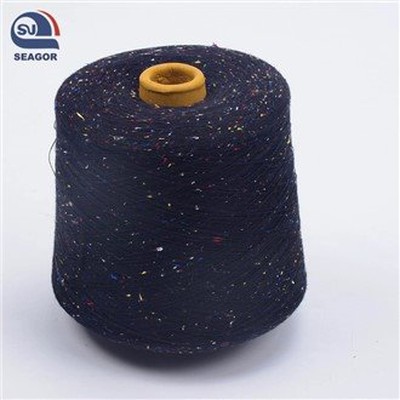


Fancy yarn fabrics are gorgeous in appearance, colorful in color, bright but not vulgar, and very decorative, which can catch the attention of consumers at the first time.
Fancy yarn fabric is a diversified and personalized product, which satisfies the consumption psychology of modern urbanites in pursuit of fashion and individuality.
Fancy yarn fabric is easy to design, because the change of yarn shape directly affects the appearance of the fabric, so it only needs to improve the selected yarn to present diversified changes on the fabric, casual and ingenious .
The production of fancy yarn fabrics requires little or no post-processing such as printing and dyeing. The process is short, the production is simple, and the product market is also very good, so it is very popular among manufacturers.
Types of Fancy Yarn
Tape yarn
Tape or ribbon yarn may be produced using various processes including braiding, crocheting, warp knitting, and weft knitting. In recent times this material has become better known especially in fashion knitwear. It is also possible to use narrow woven ribbon, narrow tapes of nonwoven material, or slit film in the same way. The taps yarns are manufactured in a tube and flat form.
Slub yarn
In this kind of yarn, the slubs are deliberately created to make desired discontinuity effect in the yarn. The slubs are thick places in the yarn that may take the form of a very gradual change with only a slight thickening of yarn at its thickest point. The thickness of the slub gets three to four-time coarser than base yarn. The yarn thickness is achieved for short yarn lengths.
Knop yarn
The knop yarn contains prominent bunches of one or more of its components. These bunches get arranged at regular or irregular distance intervals along yarn length. It is usually produced by using an apparatus with two pairs of rollers. Each pair of rollers has the capability to operate independently. This arrangement makes it possible to deliver the base thread intermittently.
Gimp yarn
A gimp yarn is a compound yarn consisting of a twisted core with an effect yarn wrapped around it so as to produce wavy projection on the yarn surface. Since a binder yarn requires providing stability to the structure so that complete yarn gets produced in two stages. First of all, two yarns of widely varying counts are plied together. Thick around thin and are then reverse bound.
Diamond yarn
A diamond yarn is produced by folding a coarse single yarn or roving with a fine yarn or filament of contrasting colour using an S-twist. This is cabled with similar fine yarn using Z-twist. Multifold cabled yarn may be made by extending and varying this technique to produce a wide range of effects.
Spiral or corkscrew yarn
This is a plied yarn displaying the characteristic smooth spiralling of one yarn component around the other. It is very similar to the marled yarn. One yarn is overfed in spiral yarn.
Boucle yarn
This type of yarn is characterized by a tight loop projecting from the body of the yarn at fairly regular intervals. These yarns consist of three different yarns. The three components of yarn are core, the effect, and tie or binder. The effect yarn is wrapped in loops around a core or base yarn. The third ply ( binder) is wrapped over the effect ply in order to hold the loops in place.
Loop yarn
The loop yarn consists of a core yarn with an effect yarn wrapped around it and overfed to produce a nearly circular loopy projection on its surface. The core yarn has two plies twisted together. Core yarn entraps the effect yarn. Generally, four yarn are used to produce this yarn. Two yarns make core or ground yarn. The effect yarns are formed with an overfeed of 200 % or more.
Marl yarn
This is the simplest fancy yarn. In this fancy yarn, two yarns of different colours are twisted together in the yarn doubling process. The texture of marl yarn looks different from normal double yarn. These yarns are used to manufacture discreet pinstripes in man's suitings. Irregular patterns are also made in the knitted fabric.
Fascinated yarn
This is a staple fibre yarn. It consists of a core of parallel fibres. These fibres are bound together by wrapper fibres. Yarn produced by the air-jet spinning process is structured in this way. The yarn produced by the hollow spindle method is also frequently as fascinated yarn, as a binder is applied to an essentially twistless core of parallel fibres.
Chenille yarn
The actual chenille yarn is produced from a woven leno structure that is slit into a narrow, warp-wise stripe to serve as a yarn. the chenille yan contains piles on its surface. The pile length gets almost uniform throughout the yarn length. The pile length may also be varied if you produce irregular pile length. These yarns are used in furnishing and apparel.
Covered yarn
The covered yarn has a core that is completely covered by fibre or another yarn. The core yarn may be elastomeric yarn such as rubber, spandex, or any other yarn. It is manufacture by single or double covering both. The second covering is usually twisted in the opposite direction of the inner covering. The fabric made with these yarn has a heavier weight.
Composite yarn
These yarns are also known as compound yarn. These yarns consist of at least two threads. One thread makes the core of the composite yarn and the other thread makes sheath components. One thread is a staple yarn and the other is a filament yarn. The compounds yarns are even in diameter and smoothness. These yarns are available in the same count range as spun and filament yarns
Metallic yarn
The metallic yarn may be made of monofilament or ply yarn. There are two kinds of processes used to manufacture metallic yarn. The lamination process seals a layer of aluminium between two layers of acetate or polyester film which is cut into strips for yarn. The metalizing process vaporizes the aluminium at high pressure and it gets deposited on the polyester film.
Structure of Fancy Yarn
The varieties of fancy yarns are ever-changing, and are generally composed of core threads, decorative threads and consolidation threads.
The core wire is the skeleton of the fancy wire and the attachment of the decorative wire. Generally, filaments or yarns with high strength are selected as the yarn core.
The fixing thread acts as a reinforcement and is used to fix the pattern, so that the pattern can be fixed in the way it was produced, so as to avoid slipping along the length direction. Most of the fixed wires are thin and strong filaments.
The decorative thread reflects the fancy effect, and the fancy patterns of the fancy yarn, such as thick details, loops, braids, etc., are all expressed through the decorative thread. Decorative threads can be produced from sliver or roving with the same draft but different overfeeds (e.g. bouclé yarn), or with different drafts (e.g. slub yarn), or from filaments with different overfeeds To produce (such as knot yarn). Using two rovings of different colors and overfeeding with different drafts and different overfeeds can produce fancy yarns with varying thickness and color.
Application of Fancy Yarn
Application of fancy yarns in woven fabrics
There are two ways to apply the fancy yarn to a woven fabric. One is that both latitude and longitude lines using fancy yarns, or full warp or full weft using fancy yarns. This is more widely used in thicker and stiffer fabrics. In general, there are fewer cases where both latitude and longitude lines use full fancy yarns, because too much embellishment in the cloth impairs the simplicity of feeling, making it too messy. There are other problems. For example, the fabric is too heavy and weaving efficiency declines, and the production cost rises. The second method is to arrange the fancy yarns and ordinary yarns in a certain proportion in the warp and weft, to adjust the warp and weft density, and to decorate the fancy yarns in the fabrics to give them a special appearance and good wearing properties. The weaving process is also convenient and the production efficiency increases.
The use of fancy yarns in worsted wool fabrics not only maintains the high-grade feel of the worsted fabric but also makes the surface of the fabric slightly garish in the simplicity. In woolen fabrics can also produce very popular products. In the yarn-dyed products, fancy yarns are the most widely used no matter the thick, medium, and thin fabrics. And the application of imitating natural fiber products and fancy gauze is becoming more and more mature.
Application of fancy yarn in knitted fabrics
When fancy yarns are used on warp-knitting weft insertion machines, most of these fabrics are used for curtains. They have good drape, a strong three-dimensional effect and a certain degree of translucency. The former warp knitted jacquard fabrics are thin and light and can no longer meet the needs of the market. Therefore, warp-knitted weft insertion fabrics are embellished with bolder fancy yarns, sometimes with combinations of different thicknesses and types into the pattern, leading to not only a strong sense of three-dimensional but also drape. A large number of high-end interior decorative fabrics are using fancy yarn as raw materials. The products mainly cover curtain fabrics, including crochet curtains, warp knitting, burnt-out, printing, jacquard, edging, burnt-out printing curtains and etc.
Like other fabrics, fancy yarn fabrics have a wide range of applications. In addition to clothing, it also involves bedding, curtains, kitchen and kitchen accessories, floor coverings, wall coverings, and furniture. From the point of style change and product characteristics, the fancy yarn fabrics have a special taste. As essential items in people’s daily life, some petty commodities can also use fancy yarns, such as gloves, socks, hats, scarves, headwear, bags, and so on.
Fiber Effects
Fiber effect fancy yarns are created during the spinning processes prior to the formation of the final yarn. These yarns are characterized by varying sizes of fiber lumps along the yarn length. Depending on the size of these fiber lumps, these fiber effects are often further divided into three subcategories: nepp, slub, and flake.
Yarn Effects
Yarn effects are also sometimes called ply effects, as these effects are created by plying two or more yarns together subsequent to the production of the single yarns. These yarns can mostly be created using the traditional ring spinning system but with additional feeding and control devices, and more recently with the hollow spindle system. These fancy yarns always contain at least two basic component yarns: the ground or core and the effect. In the majority of cases, an additional component, binder yarn, is also required to fix the effect yarn on to the ground yarn. In reality, the variety of fancy yarns is unlimited, but based on the fundamental yarn structure, they can be classified into a few basic types. It is also possible to use knitting, braiding, or other techniques to make thin strands and use them as yarns.

Properties of Fancy Yarn

Fancy yarns usually have a base or core yarn which is a traditional plain yarn, and this yarn is combined with the consequence yarn.
The consequence yarn can be held in place with a binding yarn.
Fancy yarn can be made from staple or filament fibres.
They are deliberately produced to have a malformed or irregular structure.
There are many types of fancy, novelty, and decorative yarns. They can be produced in many ways:
● Different colored fibre can be blended together then spun as one yarn.
● Color can be applied by printing or dyeing pattern onto the yarn.
● Sports of colored fibre can be twisted in with base yarn.
● Two or more threads of different, softness, thickness, weight, color, or fibre content can be twisted together.
● Raised textured can be introduced by controlling the amount and direction of the twist.
Fancy yarns can be natural or man-made fibre or a combination of both fibres.
Basic Principle of Fancy Yarn
The basic structure of a fancy doubled yarn consists of ‘core’ threads, an ‘effect material’, and a ‘binder’ which, as the name suggests, ensures that the entire structure holds together. A ground (core) component, an effect component and a binder in a fancy yarn are shown in the following figure. To obtain structural effect, longer length of effect component, relative to ground component must be present to form the required effect. Twisting of the effect component on to the ground component will produce aesthetic effect.
The basic principle is therefore to feed the ground and effect component at different speeds in to the twisting element. The percentage ratio of the effect component to the ground component is called over feed ratio.
In developing an understanding of yarn structures and types, there is no substitute for handling yarns and analyzing their structure and form. It is a valuable exercise to create a private collection of interesting yarns, and their use in fabrics.
Tips for Handling Fancy Yarn
Pattern Selection
Choose patterns that complement the unique characteristics of fancy yarn, such as open stitch patterns or designs that allow the yarn's texture and color variations to shine.
Needle and Hook Size
Experiment with different needle or hook sizes to achieve the desired fabric density and drape. Some fancy yarns may require larger needles or hooks to accommodate their bulkiness or textured elements.
Caution in Washing
Follow the recommended care instructions for fancy yarn, as some types may be delicate or prone to snagging. Handwashing or using a gentle cycle in cold water is often recommended.
Combine with Basic Yarn
Consider combining fancy yarn with a basic yarn to create interesting textures and visual contrast. This can help balance out the fancy yarn's unique characteristics and make it easier to work with.
Market Potential of Fancy Yarns
While considering the market for fancy yarns, we need to remember that these goods are not commodity items, and nor will they ever be. Their purpose is to add color or texture, or both. So market value of fancy yarns will remain negligible with compared to the rest of the textile market. But due to the consequence of liberalization in trade with countries like China a great interest in fancy yarn area is noticed in textile market all over the world. Due to liberalization in fancy yarns sector trade between Europe and Asia, the main Asian producers of fancy yarns compete with each other to offer more and more sophisticated products.
Our Certifications
ISO9001, BSCI, HIGG INDEX, BCI, ORGANIC100, OEKO TEX100, FSC, OBP, GRS

Our Factory
Xuzhou Seagor Import And Export Co., Ltd. is Founded in 2015. It belongs to Xuzhou Xinchang Company and mainly responsible for export. Located in Xuzhou City (well-known astransportation hub in China), Jiangsu province, we are only 7km, 25.7km, 200km, 470km and 590km away from Xuzhou railway station, Xuzhou Guanyin airport, Lian Yungang port Qingdao port and Shanghai Port, thus we enjoy good location. We specialize in various yarns including viscose yarn, polyester yarn, cotton yarn, blended yarn, recycled Yarn, etc.
