


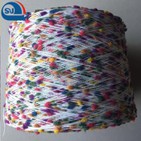


Basic process and process
Top → blending → needle carding → roving → spun yarn → yarn doubling → shaking and twisting → inspection → finished product packaging.
Spinning fibers into yarn generally go through the main processes of blowing, carding, drawing, roving, and spinning. Yarns and threads for high-end products also require additional combing operations.
Different processing procedures are required to produce cotton yarns with different requirements, such as spinning pure cotton yarns and polyester-cotton blended yarns. Due to the different raw materials used, the physical properties of various raw materials are different, and the product quality requirements are different. Different production processes are required. (With the update of modern equipment, the process has also been adjusted to varying degrees, and the equipment can merge some of these processes together, making the actual observation less work that was originally necessary)
(1) Process flow of pure cotton yarn
1. Carded yarn: blowing→carding→head merging→second merging→roving→spinning yarn→post-processing
2. Combed yarn: blowing→carding→pre-coupling→sliver roll→combing→head-coupling→two-coupling→triple-coupling→roving→spinning→post-processing
(2) The technological process of polyester-cotton blended yarn
1. Carded yarn: raw cotton: blowing→carding→
→First Parallel → Two Parallel → Three Parallel → Roving → Spinning → Post-processing
Polyester: Blowing → Carding →
2. Combed yarn:
Raw cotton: blowing→carding→pre-comb→sliver→combing→
→First Parallel → Two Parallel → Three Parallel → Roving → Spinning → Post-processing
Polyester: blowing → carding → pre-merging →
The difference between weaving yarn and knitting yarn
Woven yarn requirements: high strength, less neps.
Knitting yarns are relatively stronger than woven yarns, but have high detail requirements, and the twist is not as high as woven yarns.
Generally, the twist coefficient of woven yarn is about 380, while knitting yarn only needs about 340.
For example, 40s single yarn, the twist of woven yarn is 99 twists/10cm, and the knitted yarn is about 88-89 twists.